Project AirWorks introduces a breakthrough in active flow control, transforming how aircraft interact with the boundary layer through intelligent, adaptive surface geometry and real-time flow stabilization.
By actively controlling the transition from laminar to turbulent flow, we achieve up to 50% local skin-friction drag reduction without requiring complete aircraft redesign.
One of aviation's oldest unresolved problems is deceptively simple: why do aircraft still burn nearly half their fuel fighting the air around them?
Despite decades of aerodynamic refinement, skin-friction drag remains one of the industry's most persistent and expensive inefficiencies. This drag arises from the interaction between the aircraft surface and the boundary layer, the thin layer of air directly adjacent to the wing.
The critical factor is the laminar-to-turbulent transition. In laminar flow, air moves in smooth, parallel layers with minimal energy loss. As flow velocity increases or surface conditions change, this laminar flow breaks down into turbulent flow, characterized by chaotic, energy-dissipating eddies. Once turbulent, the boundary layer generates significantly higher skin-friction drag.
Traditional passive aerodynamics have plateaued. Wing shaping, surface coatings, and fixed riblet patterns offer only marginal improvements and degrade under real-world conditions: contamination, wear, and varying flight regimes. The industry needs an active solution that responds to flow conditions in real time.
At Project AirWorks, we reject the assumption that only marginal gains are possible.
In aviation, small efficiency improvements compound. Lower fuel burn reduces operating costs, accelerates fleet renewal, enables broader connectivity, and significantly reduces emissions. A 10% reduction in fuel consumption across a commercial fleet translates to millions of dollars in annual savings and thousands of tons of CO₂ avoided.
Every percentage point of drag reduction directly reduces carbon emissions. For a global fleet, this compounds into meaningful climate impact.
Lower fuel costs improve airline profitability and enable route expansion, making air travel more accessible.
Airlines operate under strict maintenance schedules and cost pressures. Solutions must integrate seamlessly with existing platforms.
Our solution combines AI-controlled adaptive surface geometry with localized boundary-layer suction to actively stabilize laminar flow in real time.
Instead of passively accepting flow breakdown, the wing continuously senses early instability and responds instantly, delaying the transition from laminar to turbulent flow during flight.
Distributed pressure and temperature sensors monitor the boundary layer in real time, detecting the earliest signs of transition before turbulence fully develops.
Machine learning algorithms process sensor data and predict flow behavior, optimizing control responses across varying flight conditions and environmental factors.
Micro-actuators adjust surface geometry locally, modifying curvature and surface features to maintain favorable pressure gradients that sustain laminar flow.
Targeted suction removes the slowest-moving air from the boundary layer, preventing the velocity profile from becoming unstable and triggering transition.
This is active flow control, not incremental aerodynamics. The system responds to actual flight conditions, adapting to altitude, speed, angle of attack, and environmental factors in real time.
The result is up to 50% local skin-friction drag reduction, significantly improved fuel efficiency, and substantially lower emissions, achieved without requiring a complete aircraft redesign.
Measured at the boundary layer interface
Local improvements compound across the airframe
No radical airframe redesign required
While our 50% reduction is measured locally at the boundary layer, its impact extends across the entire aircraft. Reduced skin-friction drag on the wing lowers total drag, which directly reduces thrust requirements and fuel consumption. For a typical commercial aircraft, even a 5-10% reduction in total drag translates to substantial fuel savings over the aircraft's lifetime.
This is active flow control, not incremental aerodynamics. By actively managing the boundary layer, we achieve performance gains that passive solutions cannot match, especially under the variable conditions of real-world flight.
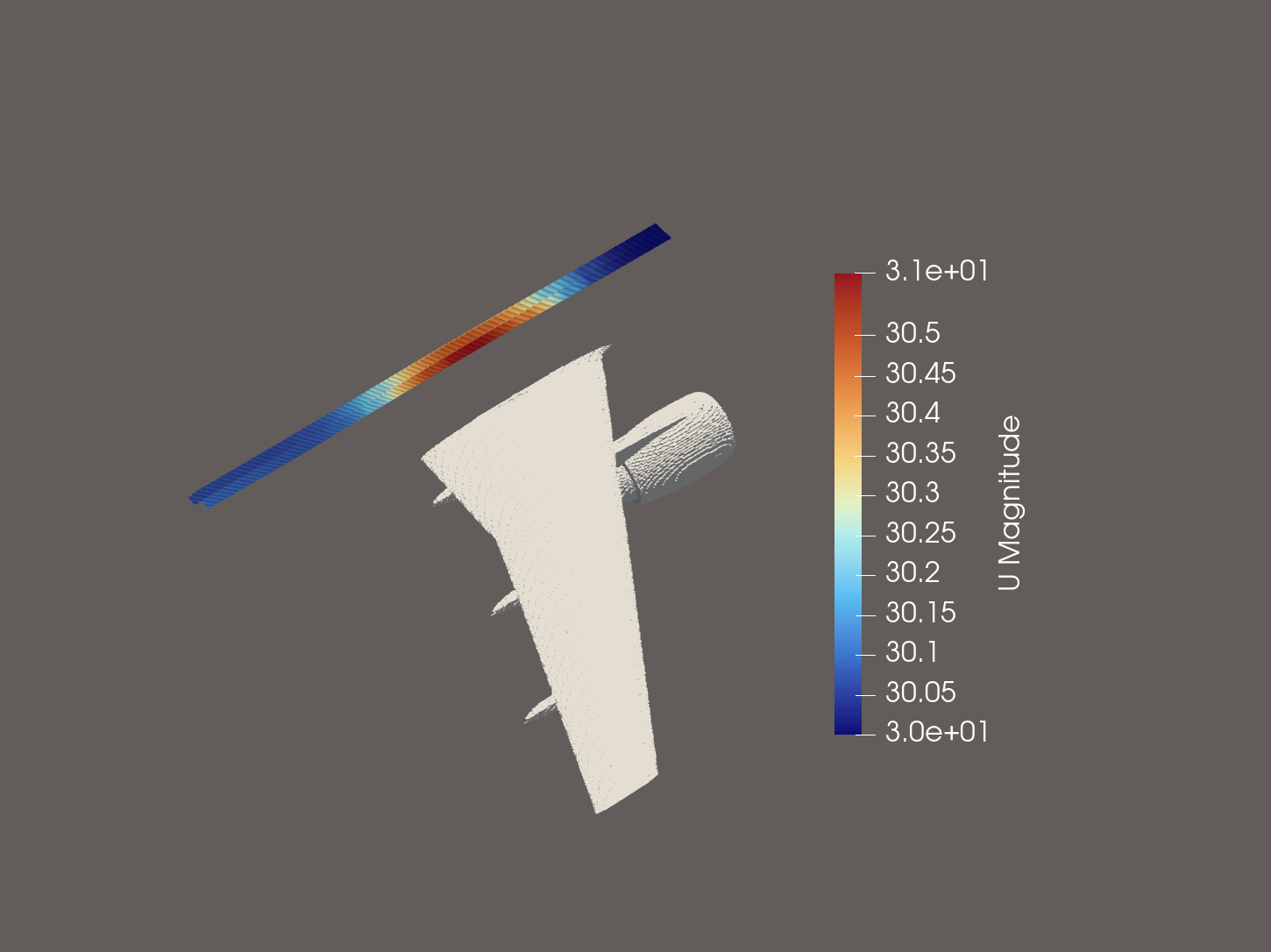
This computational fluid dynamics (CFD) model is designed for qualitative aerodynamic analysis and visualization, rather than high-fidelity performance prediction.
The simulation reliably captures overall flow behavior, including velocity distribution, pressure trends, wake direction, and streamline patterns around the wing. These features are considered moderately accurate (≈60–70% confidence) and are well-suited for understanding aerodynamic phenomena and comparing design concepts.
However, absolute lift and drag values carry significant uncertainty. Due to laminar flow assumptions at high Reynolds numbers, the absence of boundary-layer mesh refinement, and simplified numerical schemes, the estimated accuracy is approximately:
As a result, this model should be used for visual insight, trend analysis, and conceptual evaluation, not for precise aerodynamic certification or final performance claims.
By explicitly quantifying uncertainty and limitations, this approach prioritizes scientific honesty, transparency, and sound engineering reasoning.
Our mission is to radically reduce aircraft skin-friction drag through intelligent, adaptive flow control. By transforming aerodynamics from passive to active, we aim to make aviation cleaner, more efficient, and fundamentally smarter.
Project AirWorks is not just about saving fuel, it is about reshaping how aircraft interact with the air itself.
By actively controlling the boundary layer, we enable cleaner, more efficient aviation without waiting decades for radical airframe redesigns, with a clear pathway toward commercial-scale adoption.
Challenging assumptions about what's possible in aerodynamic efficiency.
Combining computational intelligence with rigorous fluid dynamics and mechanical design.
Environmental impact reduction through fundamental efficiency gains, not offsets.
Every claim grounded in physics, validated through simulation and testing.
Leads Project AirWorks, setting strategic direction and overseeing research, technical writing, and refinement.
Drives digital innovation, focusing on computational development, simulation, and clear technical communication.
Anchors real-world feasibility, leading product design and management through a strong understanding of physics, usability, and implementation constraints.
Learn more about how Project AirWorks is transforming active flow control in aviation.